Book Banning on the Rise in the UK
In November 2025, a Greater Manchester school removed nearly 200 books, from Becoming by Michelle Obama to LGBTQ+ titles, putting a librarian under investigation and echoing America’s wave of book bans.
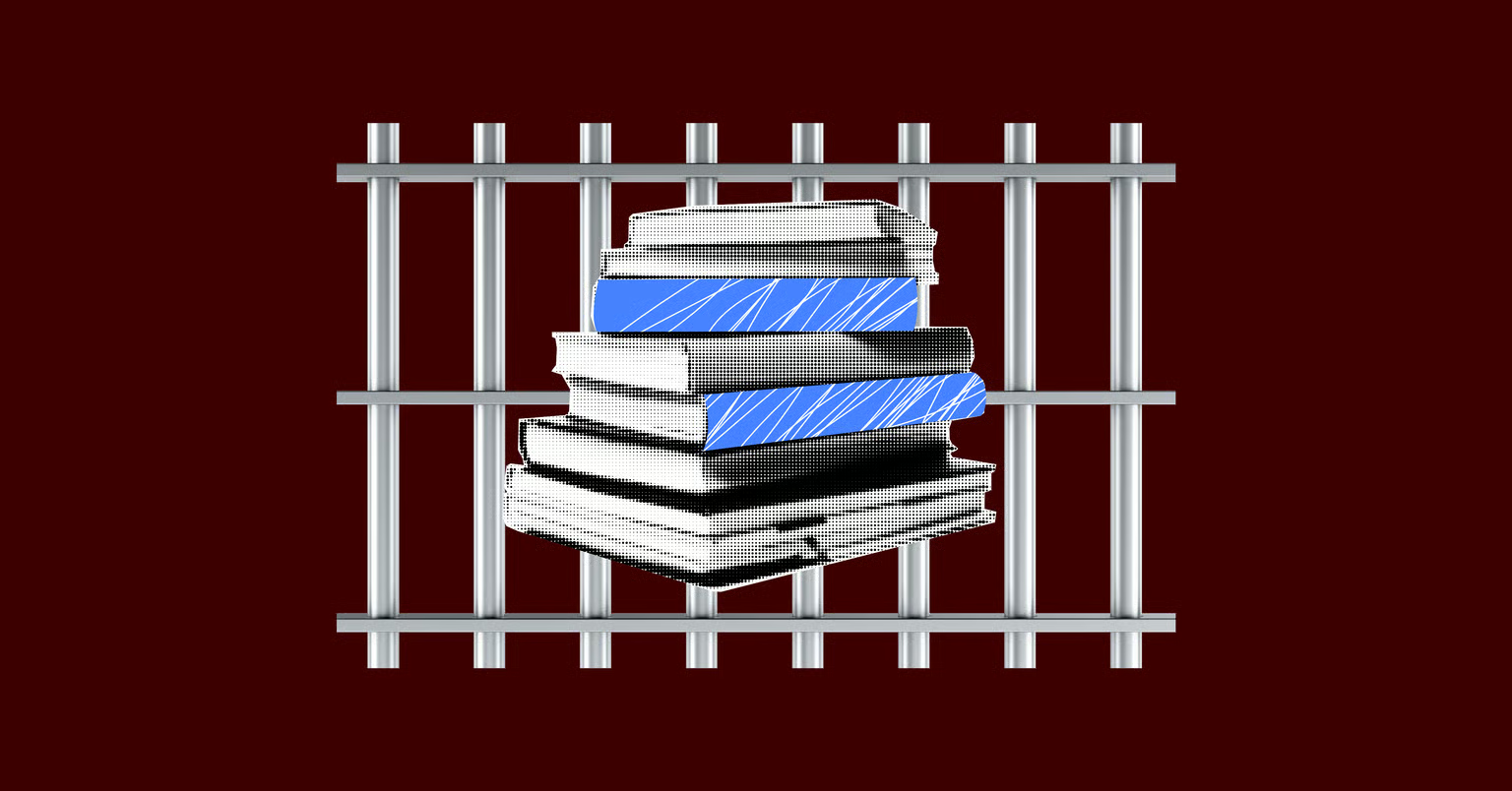
It’s difficult to imagine a world in which books could pose a threat, yet it’s beginning to resemble ours, now more than ever.
Just recently, the Index on Censorship reported on growing cases of book banning within the UK. Using an alias to ensure safety, a school librarian from Great Manchester, ‘Emily’ spoke to the Index of Censorship about her recent disciplinary hearing. It began with Laura Bates’ Men Who Hate Women, and escalated to far more than just one title.
Emily entered the school library the following day, only to notice gaps where books had once been. In the weeks that followed, she was reported to local authorities, an investigation was to take place on safeguarding complaints and she was given a spreadsheet by the school containing 200 titles that were deemed ‘inappropriate’.
Titles like Why I’m No Longer Talking to White People About Race by Reni Edo-Lodge, Becoming by Michelle Obama, The Notebook by Nicholas Sparks, We Should All Be Feminists by Chimamanda Ngozi Adichie and multiple LGBTQ+ titles sat within that list, and it posed a question that is essential to reckon with: Why are books that incite discussion feared?
It’s no surprise that we are seeing the instance of book banning become more common in the UK. In recent years, the United States has seen widespread efforts to remove books from schools and libraries, targeting some of the most recognisable titles. Works like Charlotte’s Web, The Handmaid’s Tale, and Animal Farm are just a few among thousands that have been challenged or removed. According to The Brown Daily Herald, since 2021, there have been at least 22,810 instances of book bans in public schools across the United States.
The act of book banning has been widely excused as a means of protection, shielding students from complex or ‘inappropriate’ topics. Yet discourse around the phenomena argue the rationale masks a deeper impulse: the desire to control narratives and avoid political discomfort. Critics argue that in this sense, book banning begins to resemble a form of self-censorship, one that aligns uneasily with broader concerns about rising authoritarian tendencies.
Books are not designed to comfort us at all times. They are there to provoke, to challenge assumptions, to evoke emotion, and, at times, to unsettle.
As Andrew Solomon, a professor at Columbia University, has argued, “Reading a book you hate forces you to think about why you hate it.” That friction, he argues, is never a flaw, but in actual fact a vital part of intellectual growth.
Similarly, Chimamanda Ngozi Adichie has spoken about the responsibility of literature to challenge its audience: “I don’t want you to read one of my books and be like, ‘Oh, it’s fine’… One of my jobs is to shake you and tell you to look at this thing differently.”
In a cultural moment increasingly defined by attempts to restrict access to ideas, it is perhaps more important than ever to defend the role of libraries and those who protect them. The 2025 documentary The Librarians offers a timely look at the pressures faced by library workers, particularly in the United States, as they navigate increasing scrutiny over the books they provide and the communities they serve.
To control what people can or cannot read, then, is not merely to curate information, it is to narrow the boundaries of thought itself.
Sources
https://www.brown.edu/news/2026-03-30/banned-books-discovery-through-dialogue


